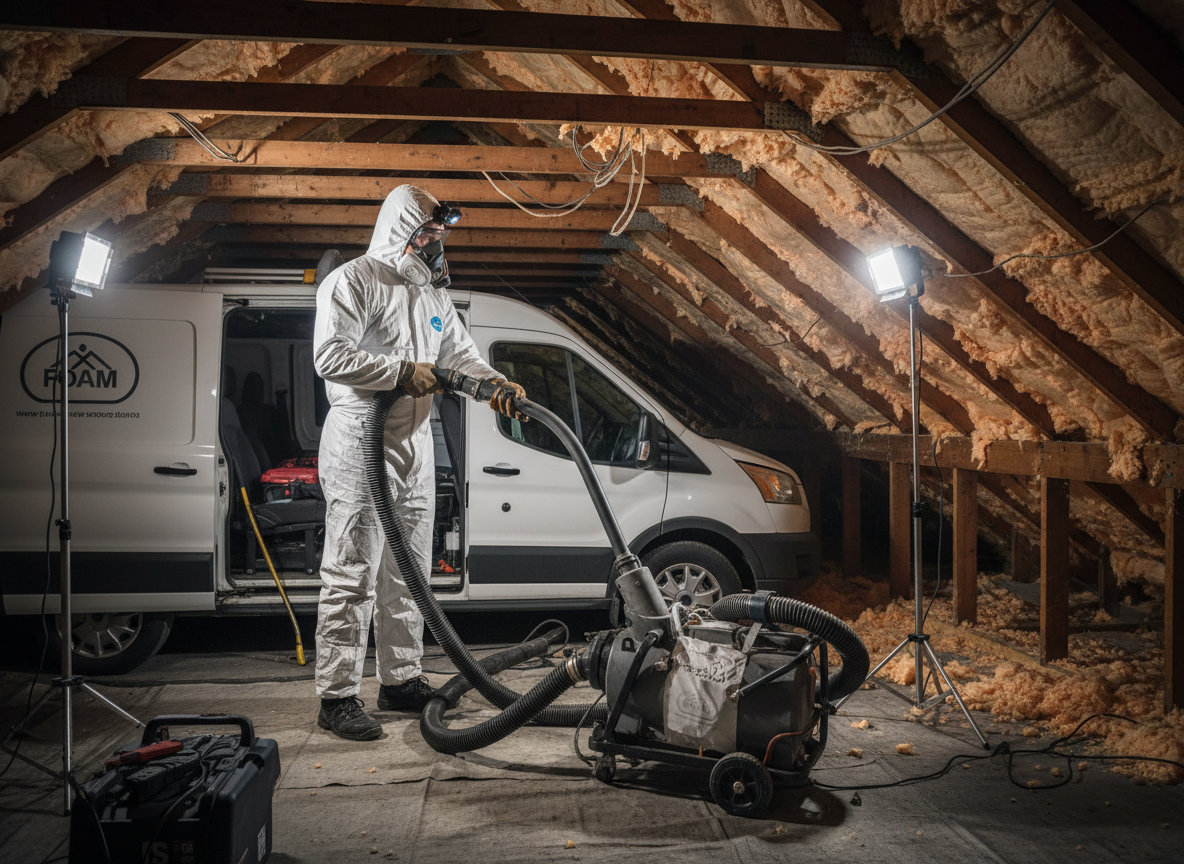
York's older housing stock, particularly Victorian terraces and semi-detached homes in areas like Heslington and the city centre, often contains spray foam applied decades ago in lofts and cavity walls. Removing it requires careful assessment because the foam can conceal timber rot or poor ventilation, especially after prolonged wet winters that raise moisture levels in the Vale of York. Technicians must work methodically to avoid disturbing asbestos-containing materials common in pre-1980s builds while ensuring the property remains weather-tight overnight.
Night calls frequently involve properties where foam has failed due to condensation build-up, leading to musty odours or ceiling staining. In these cases the work begins with isolating the affected space, then using negative air machines to control dust before mechanical removal. York’s narrow access lanes and terraced layouts mean equipment has to be carried through homes rather than craned, extending the time needed for safe extraction and debris clearance.
After the foam is gone, surfaces are cleaned and inspected for underlying defects such as failed felt or blocked vents. Homeowners in the York area are advised to allow time for the structure to dry before any new insulation is considered, particularly during the colder months when external temperatures slow evaporation. This sequence prevents repeat problems that arise when new materials are installed over still-damp timber.
Technician insight
In York the thing that catches most people out with 24/7 Spray Foam Removal is how quickly damp from the Ouse and Foss catchments gets trapped behind foam in pre-war terraces; if the extraction stops at the visible layer the joists stay wet and the problem returns within two winters.
Heslington Terrace Loft Extraction
Homeowner reported strong musty smell after heavy rain. Inspection found spray foam bridging a blocked vent in a 1930s terrace. Crew removed the foam, cleared the vent, and left the space open for drying; the odour disappeared and no further rot developed.
How it works
- 1
Initial Assessment
Technician arrives within hours, inspects loft and wall cavities, and identifies hidden moisture or access constraints typical of York terraces.
- 2
Containment Setup
Dust barriers and negative air units are installed to protect living spaces before any material is disturbed.
- 3
Foam Extraction
Mechanical and manual methods remove the foam while checking for timber damage or older insulation layers.
- 4
Site Clearance And Drying
Debris is removed, surfaces cleaned, and ventilation restored so the property can dry before further work.
Pricing
Upfront quotes issued after on-site inspection; final cost depends on access difficulty and volume of material.