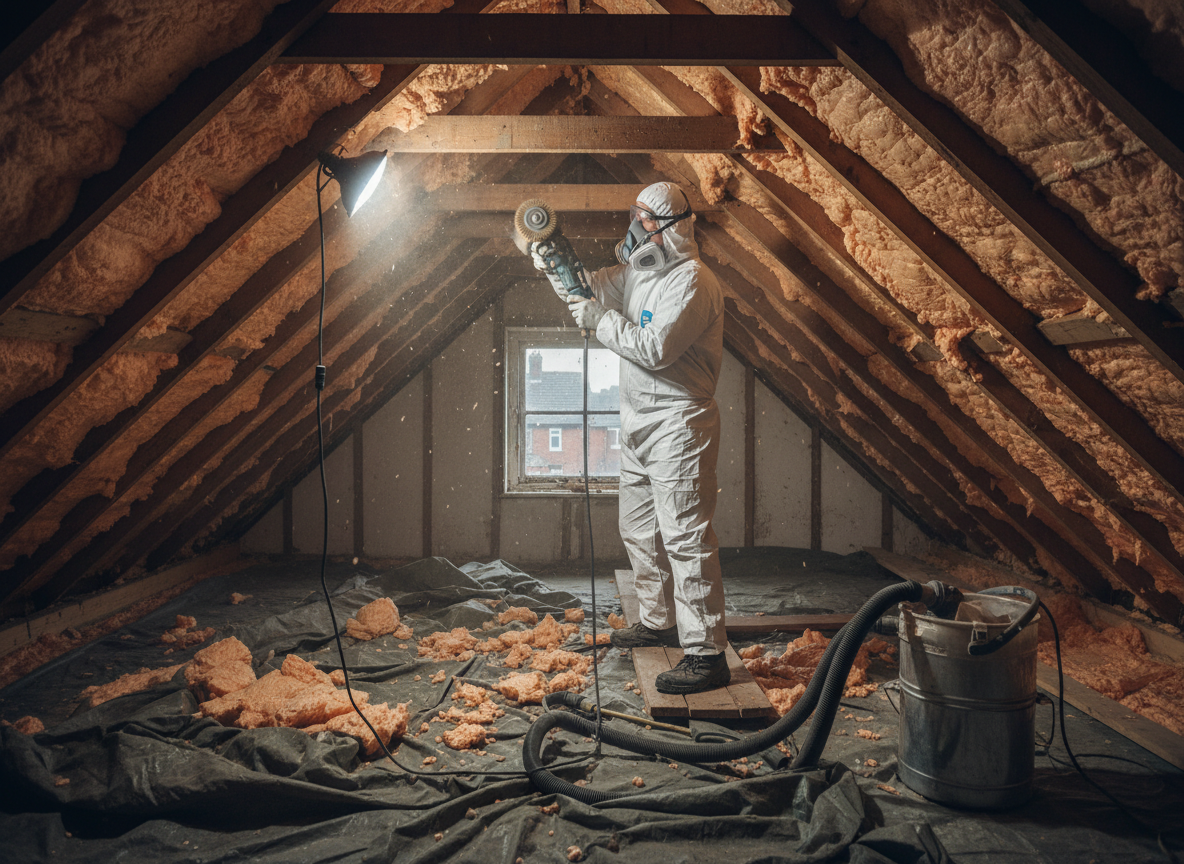
York's housing stock includes many Victorian terraces and early 20th-century properties where spray foam was applied directly to roof voids and between joists. Over time the foam can trap moisture against brickwork and timber, especially after the region's frequent winter rainfall and poor loft ventilation. Removal requires cutting the material in controlled sections while protecting original lath and plaster ceilings below, then clearing residual adhesive without disturbing wiring runs that often sit close to the joists in these older builds.
Edge cases commonly arise around chimney stacks and party walls in terraced homes near the city centre. Closed-cell foam bonded to stonework can pull small fragments loose during extraction, so work proceeds slowly with hand tools rather than powered equipment. Open-cell foam in post-war semis around Heslington tends to crumble into dust that must be vacuumed thoroughly to prevent it settling into downstairs rooms through floor gaps. Local building control sometimes requires notification if the removal affects fire separation between properties.
After foam is gone, the roof void needs time to dry before any new insulation is considered. In York properties this drying period can stretch longer than expected because of the clay subsoil and limited airflow in narrow ginnels. Homeowners are advised to monitor for recurring damp patches on ceilings, particularly after heavy rain, and to improve ridge and eaves ventilation before re-insulating.
Technician insight
In York, the thing that catches most people out with Residential Spray Foam Removal is how Victorian brickwork around the city centre and in Heslington retains moisture for weeks after the foam comes off, especially following the heavy winter rains that soak the clay soil here.
Terrace Loft Near York Minster
Homeowner reported persistent loft odours in a 1890s terrace. Inspection showed closed-cell foam trapping damp against the chimney breast. We removed the foam in small sections to avoid disturbing the stack, cleared adhesive residue, and opened additional ridge vents. The void dried out and the musty smell disappeared.
How it works
- 1
Site Assessment
We inspect the roof void, identify foam type and thickness, check for hidden wiring or pipework, and note any moisture issues in the York property.
- 2
Containment Setup
Dust sheets and extraction fans are placed to protect living areas below while we work from the loft.
- 3
Foam Extraction
Material is cut away in sections using hand tools, with adhesive scraped from joists and brickwork without damaging original features.
- 4
Clearance and Ventilation Check
All debris is removed, the void is vacuumed, and ventilation paths are confirmed before leaving the site.
Pricing
Price depends on property age, foam depth, and access difficulty in York homes.