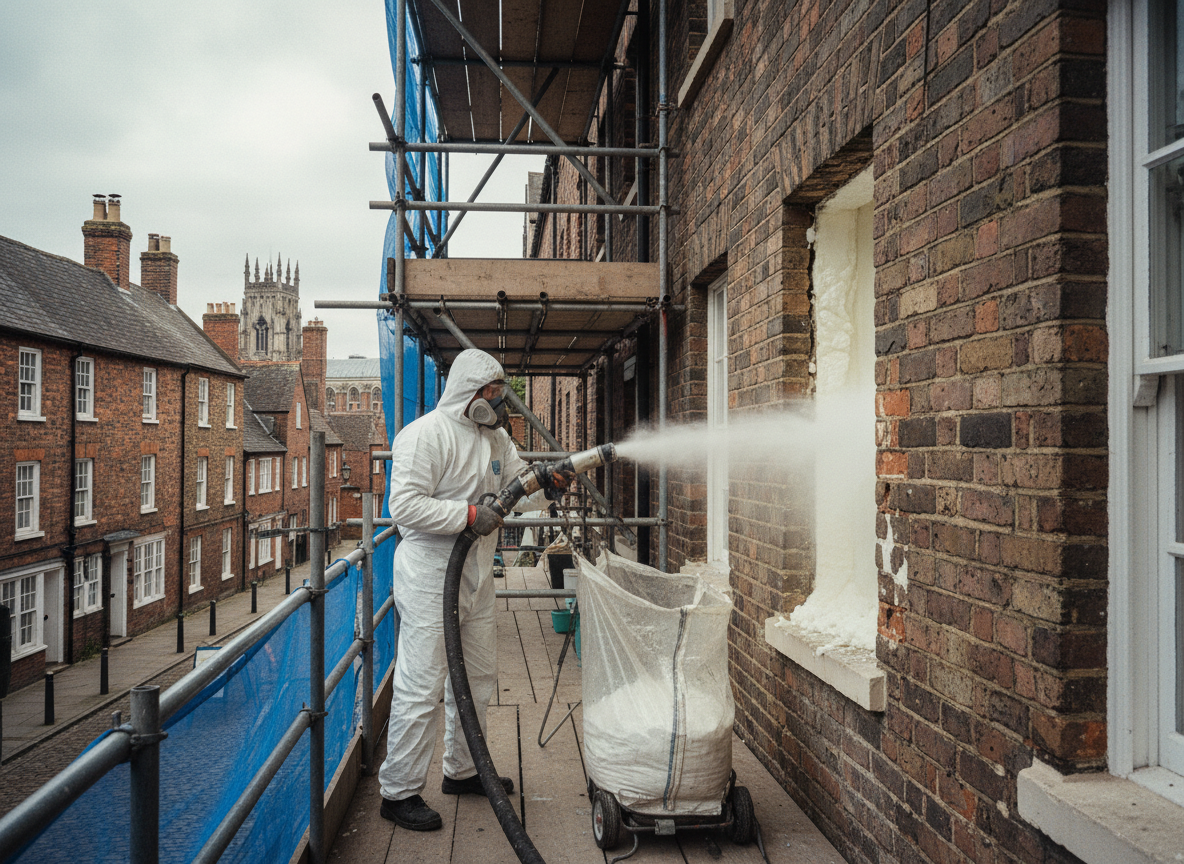
York's housing stock includes many post-1920s terraces and semis with cavity walls that received urea-formaldehyde or polyurethane foam fills during the 1970s and 1980s. Over time these foams degrade, shrink, and trap moisture against the inner leaf, especially where the River Ouse and local clay soils keep ground dampness high. Homeowners in Heslington, Fulford and similar areas often discover the problem only after internal mould or cold spots appear. Removing the material requires careful drilling patterns to avoid damaging brickwork and full extraction of residue before any new insulation or ventilation is considered.
Winter rainfall and freeze-thaw cycles in North Yorkshire accelerate breakdown of the foam, allowing water to migrate across the cavity and reach timber joists. Standard removal involves sequential extraction from both sides of the wall, followed by inspection for rot that may have gone unnoticed for years. In properties near the city walls or in older estates, narrow cavities and irregular brick courses demand slower, more precise work than newer builds. Skipping this step risks leaving damp pockets that reappear after redecoration.
Local building practices in York mean many cavities were filled without proper weep holes or ventilation upgrades. During removal, technicians must check for blocked air bricks and ensure the wall can breathe again once the foam is gone. This prevents recurring condensation issues that homeowners frequently mistake for roof leaks. Work is scheduled around the property's occupancy to minimise disruption while maintaining safe access from the street in tight York terraces.
Technician insight
In York, the thing that catches most people out with Cavity wall spray foam removal is how often the foam sits against saturated inner brickwork in terraces near the Ouse, where clay soil and winter rain keep the cavity wet long after the foam is gone. Homeowners assume once the material is out the problem ends, but missed weep-hole clearance or blocked air bricks lets damp return within a season.
Hidden Rot Behind Foam in a Fulford Terrace
Problem: persistent internal damp on a north-facing wall. What we found: degraded 1980s foam holding moisture against joist ends. What we did: extracted the fill, cleared blocked air bricks, and confirmed drying before handover. Outcome: wall dried without further intervention.
How it works
- 1
Site Assessment
Inspect both internal and external walls to map cavity fill condition and identify moisture paths typical in York terraces.
- 2
Access Preparation
Drill strategic extraction points while protecting garden areas and avoiding damage to original brickwork common in Heslington properties.
- 3
Foam Extraction
Remove foam and residue using specialist equipment, clearing debris from the base of the cavity before final checks.
- 4
Ventilation Restoration
Clear or reinstate air bricks and verify drainage so walls can dry naturally after the York winter rains.
Pricing
Upfront quotes provided after on-site inspection; final cost depends on property age, cavity depth and access constraints in York streets.